
Defeating Entropy
Bringing more engineering approaches to medicine for human health and longevity

In 1967, Christiaan Barnard performed the world’s first human heart transplant on Louis Washkansky, 53 year-old grocer with a heart failure. Washkansky survived only 18 days. The second patient, Philip Blaiberg, survived 19 months. Today, over 8,000 heart transplants are performed every year worldwide. In the United States alone, more than 46,000 organ transplants were performed last year.
But that is not enough, roughly 17 people die every day waiting for an organ in the in the US alone.
Medicine needs an engineering upgrade. The reality is that each of us walks around with organs of different biological ages. The thymus is at the end of its life by 40, ovaries by 50, and so on. We age organ by organ. We could replace the organs that age fastest and are most critical for survival instead of a whole body suicide with the failing organ.
Five questions worth pondering on
1. What if we can replace brains the way we replace hearts?
Patients with slow-growing benign tumours adapt and survive with gradual brain rewiring and neuroplastic compensation. The assumption that the brain is fundamentally irreplaceable may not be absolute. What the field is exploring now are bioelectrically conductive scaffolds and hybrid biological-synthetic interfaces to give time for gradual functional rewiring.
2. What if we can build hibernation pods, for medicine first, and space travel after?
Nature already invented time machines. Bears. Tardigrades. The 13-lined ground squirrel has found the metabolic switch off key. Therapeutic hypothermia (putting patients in cooling blankets to 32°C–36°C degrees) is already used in medicine today since the 90s, but it is crude and limited to 24–72 hours. This is way far months of metabolic pause at freezing temperatures.
3. What if we can 3D print organs on demand?
The UK transplant waiting list has over 7,000 people at any given time. Around 400 die each year while in the waiting list. We wait for someone to die — in the right conditions, at the right time, in the right geography — to save someone else. Bioprinting vascularised, functional tissue, biohybird organs at scale on demand would be a defining feat of bioengineering.
4. What if cryopreservation could hold organs and whole bodies until better solutions exist?
We often run out of time when help is within sight but not yet available. This is true for donor organs that must be transplanted within hours. It is true for a 10-year-old with a deadly glioma who may need five more years until the right therapy exists. New cryoprotective agents, vitrification without toxicity, volumetric rewarming without fracturing tissue are all needed today more than every. Cryobiology is underexplored.
These are some of the questions we will explore at least for a weekend.
On 20–22 March, we are coming together with the techno-optimist SOTA community to bring 100 builders, scientists, clinicians, bioengineers, hardware engineers, and AI engineers together in London to bring an engineering mindset into medicine for human longevity.
36 hours of AI, engineering, and bioengineering in one room.
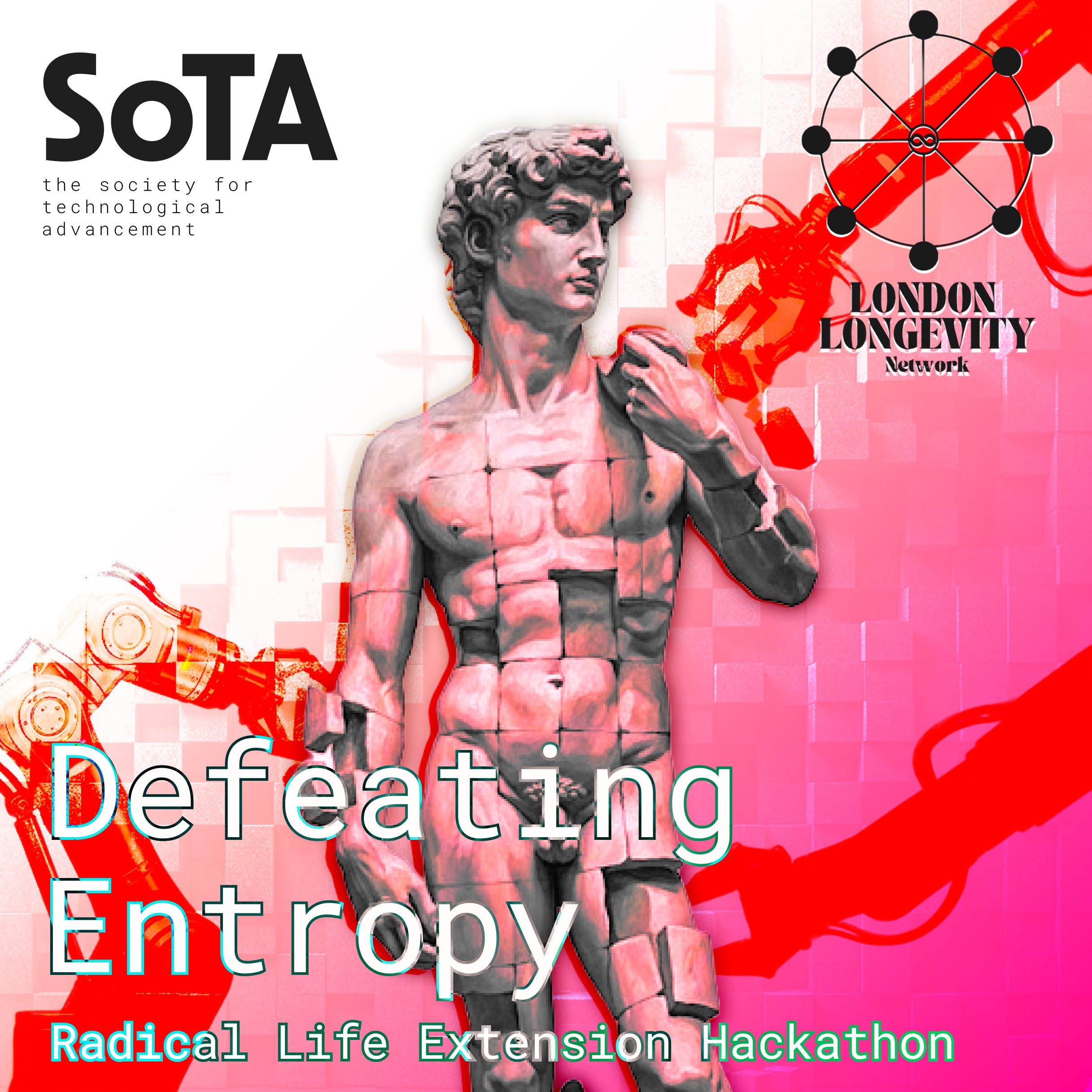
Defeating Entropy — A Radical Life Extension Hackathon 20–22 March 2026 | London
Two themes: Replacement · Biostasis
We will kick off by a debate “Can Whole Brain Emulation Solve Longevity” — Friday 20 March (open for everyone)
A contested question, with many neuroscientists are either skeptical or believers that "Pantheon Style Uploaded Intelligence” is achievable and potential strategy for longevity. That is worth taking seriously. It is also worth asking whether their assumptions are load-bearing. We are hosting a debate on exactly this question on Friday night — two founders, no consensus guaranteed.
Christian Larsen — Co-founder and COO of NethoLabs, working on whole-brain neuroscience and emulation technologies.
Daniel Burger — Co-founder of Synconetics Organization and EightSix Science, developing biohybrid gradual brain replacement and functional brain extraction technologies.
Moderated by SOTA cofounder, Levan Bokeria, neuroscientist at the Alan Turing Institute
Defeating Entropy Hackathon — Saturday 21 – Sunday 22 March
This is only possible because of visionary supporters: Fifty Years (powered by ARIA), Pillar VC, CryoDAO, Klona Biotech, Tomorrow Bio, and many others.
If you would like to get involved or contribute, get in touch.
At the London Longevity Network, we believe you only live once, and we are bringing people to make that once significantly longer and healthier for everyone.